

Hotel technology stack consolidation means reducing duplicated work and clarifying how the hotel’s systems share information. Start by mapping reservations, room status, rates, messages and tasks, then identify which system owns each record. The aim is a dependable daily workflow, not simply a smaller number of subscriptions.
Count the handoffs as well as the tabs
A hotel stack accumulates one reasonable purchase at a time: a property management system, a channel manager, booking tools, review platforms, accounting software and a spreadsheet that solved an urgent problem years ago. The team inherits the combination, even if nobody ever designed it as a whole.
Stand beside reception and follow a real question: is a suitable room available tomorrow, what can be quoted and who needs to know if the guest books? Record the tools opened and the information copied. Several screens may be appropriate, but the same reservation should not acquire conflicting versions as it moves between them.
Manual copying is a useful place to investigate, not proof that a system is broken. Ask why the step exists, how often it happens and what checks catch errors. An occasional controlled export may be sensible; repeatedly retyping changes during a busy shift deserves closer attention.
Use a simple technology audit
- Tool and purpose: list each system, spreadsheet and operational chat the hotel uses.
- Record owner: identify where each important fact is created and which system is authoritative when values differ.
- Data movement: note integrations, exports and manual copying, including who checks that transfers succeeded.
- People and access: record which roles need the tool and who owns account administration.
- Cost and dependency: include subscription costs, support needs, contract terms and work required to leave.
- Failure response: state what the team does when the tool or connection is unavailable.
Complete the audit with people from reception, housekeeping, management and the back office. A tool that appears redundant to one department may hold the only usable record another department relies on. Ask what would stop working tomorrow if you removed it.
Give each fact a clear owner
Consider an illustrative room-status handoff. A housekeeper marks a room clean, maintenance discovers a lock fault and reception still sees the room as available. The problem is not necessarily the number of applications. It is that the team has not defined which status controls guest assignment and how changes reach the desk.
Write the rule before choosing a replacement: who may release a room, which record reception reads and how an out-of-service change is communicated. Apply the same reasoning to reservation amendments and rate changes. An integration that moves data quickly still needs clear ownership and a way to handle errors.
A useful system lets the team act on the same facts without rebuilding the picture every shift.
Test a workflow before replacing a tool
Choose one troublesome workflow and test it from beginning to end. For an arrival, include a booking change, a delayed room and a message passed to the next shift. For channel distribution, include a rate update and a failed connection. Evaluate what staff can see and do when the normal sequence does not work.
Request a demonstration using realistic examples rather than accepting a list of integrations. Check whether the connection supports the specific data and actions you need, whether updates work in the required direction and how exceptions are surfaced. A connected logo does not describe the full operational contract.
If the proposal includes AI, apply the same test to hotel AI assistance. Staff should understand the information behind an answer and review consequential actions. Adding an assistant does not by itself resolve conflicting source records.
Plan the transition and the way back
Before a switch, inventory the records to be transferred, verify a recoverable backup or export and define who will validate the result. Check a representative set of reservations, room types and operational records. Agree when the new system becomes authoritative and how changes made during the transition will be reconciled.
Include guest data protection in the plan: access permissions, necessary retention, exports and the handling of accounts in the old system. Cancelling a subscription is different from deciding which records may be deleted. Keep those decisions explicit and based on the property’s obligations.
Train the people who will use the system on an ordinary shift and on the exceptions they actually encounter. Set a fallback procedure for a failed cutover or unavailable connection. Retire an old tool only after its necessary records and functions have been accounted for.
Choose fewer obstacles to a clear picture
Review the result after the team has used the workflow through a range of normal days. Look for repeated copying, disputed numbers, lost handovers and work that now needs an unexpected workaround. Success is a clearer process the team can maintain, not a promise that every task has become automatic.
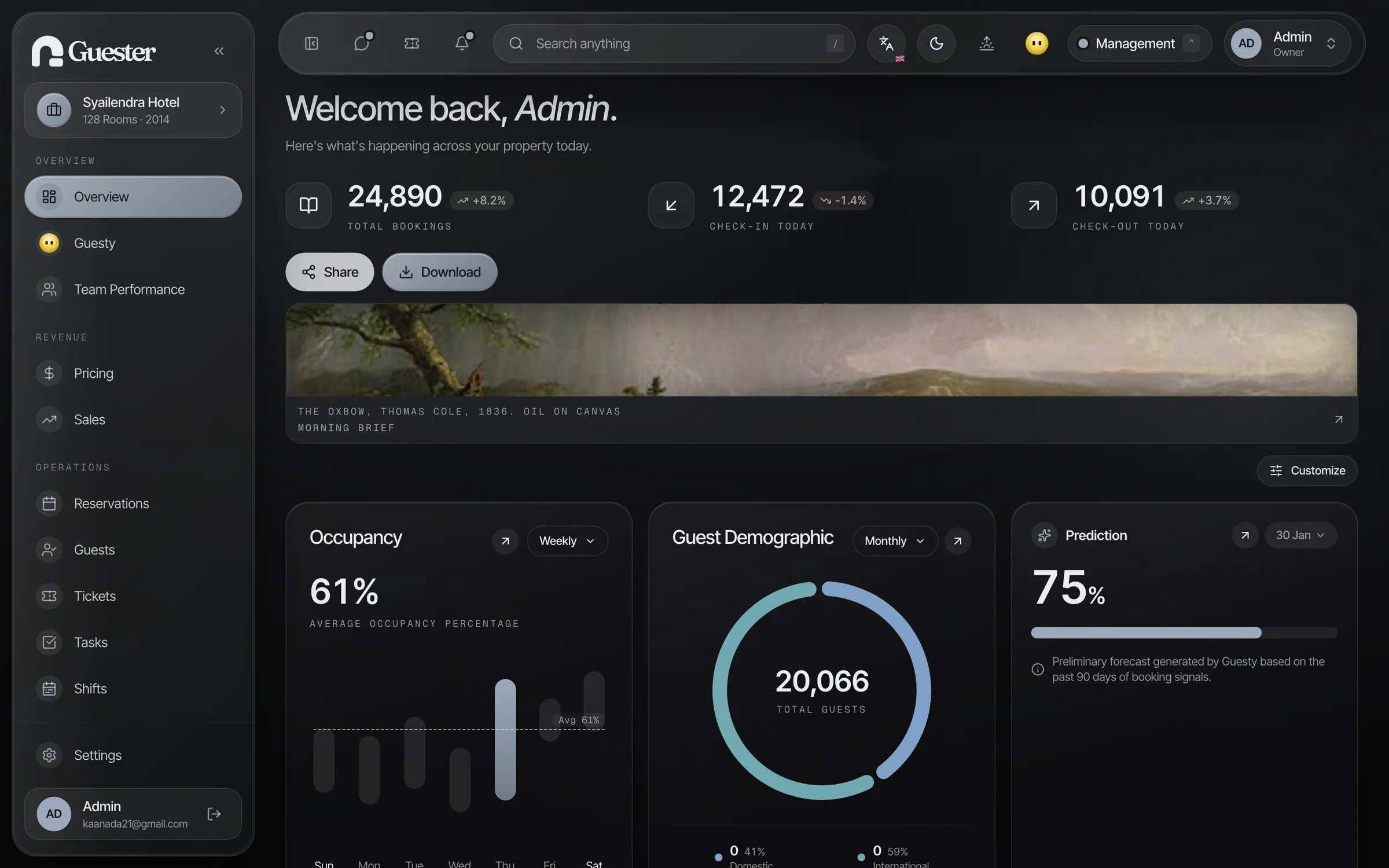
The overview shown in Guester’s hotel operations workspace offers a starting point for that conversation. Bring your audit to a demo and examine the records, handovers and connections your property requires. Like the small marks that compose a painting, the facts matter because of the picture the team can read together.